


Woven Rugs
Also known as Iranian rugs, they are celebrated for their intricate designs and exceptional craftsmanship. Persian rugs often feature floral patterns, geometric designs, and pictorial scenes. They are renowned for their fine knots and elaborate motifs. Regions such as Tabriz, Isfahan, and Kashan produce some of the finest Persian rugs in the world.
Why Choose Us
Our Company
Established in 2015, our factory is located in Pujiang County. It covers 12,000 square meters and employs over 100 staff members. We have a professional team dedicated to ensuring the quality of our products.
Production Equipment
We operate our own production lines for jacquard carpets, yarn-dyed carpets, and digital printing carpets.
Our Service
As a factory, we work closely with esteemed clients from quotation and sample confirmation to production and delivery.
Our Product
We have our own factory, We offer high-quality products, mainly including various types of bath sets and carpets.

Stripes Woven Yarn Dyed Mats
MOQ: 300 Square Meters per Color
Payment term: T/T, L/C or Payment against BL

Striped indoor area rugs are a great way to add style and personality to any room. They come in a variety of colors, widths, and materials, so you can find one that perfectly complements your décor.
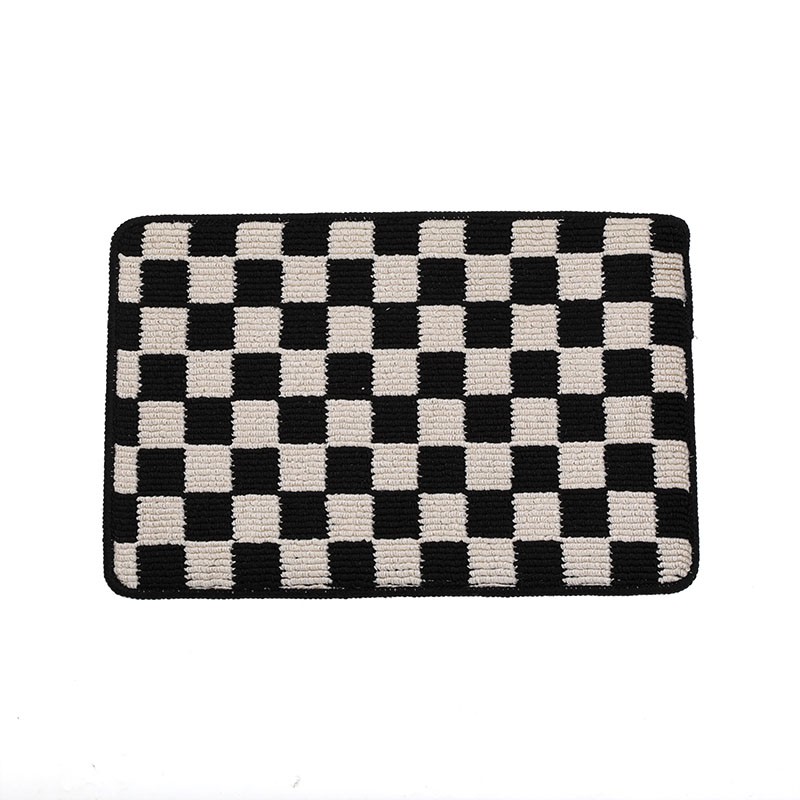
Striped Carpets for Bathroom
MOQ: 300 Square Meters per Color
Payment term: T/T, L/C or Payment against BL

Embroidery bath mats are a popular choice for bathrooms because they are both stylish and functional. They come in a variety of colors and sizes to match your bathroom decor, and they can help to absorb water and prevent slips.Embroidery bath mats are a popular choice for bathrooms because they are both stylish and functional. They come in a variety of colors and sizes to match your bathroom decor, and they can help to absorb water and prevent slips.

U-Shaped Yarn Dyed Toilet Rugs
U-shaped yarn-dyed toilet rugs are a popular choice for bathrooms because they are both stylish and functional. The U-shape contours around the base of the toilet, and often extends in front of it, providing a comfortable place to stand while using the toilet. Yarn-dyed rugs are made by dyeing the yarn before it is woven, which results in a rich, consistent color throughout the rug.

Woven Rugs Factory
MOQ: 300 Square Meters per Color
Payment term: T/T, L/C or Payment against BL
The features that make the woven rugs of high quality are the type of pile yarns, the knot density, and the knot's shape. Machine woven rugs offer countless options in the market with their different varieties, on the other hand, all hand-woven rugs are produced by weaving technique.
Tips for Selecting a Woven Rug
After measuring and determining the size of the woven rug you will buy, you should decide which color or colors and patterns it should have. You should consider both your whole home decoration style and your living space where you will use the woven rug. For example, if you have an intense home decoration, you should choose a woven rug in simpler and planer colors.
You should decide how many rugs you will buy according to the size of the room you will choose a woven rug for. Because now, more than one rug in the same living space has become very popular.
What material will you buy a woven carpet made of? First, you must find the answer to this question. The answer will vary depending on which room or living area you will use the carpet in.
it may not be right to choose rugs made of natural materials such as wool in areas such as kitchens, patios, outdoor living spaces, and entrances. This is because these areas are high-traffic areas, and they are very suitable floors for getting dirty quickly. Therefore, it would be more correct to use rugs made of synthetic materials, which are petroleum by-products, instead of natural fibers in these areas.
An area rug can be considered a soft fabric because soft materials are also preferred in making these rugs.
Flatweave rugs are the most preferred rug type among woven rugs.
If you want to use an easy-to-use, easy-to-clean, and even washable rug for your home decoration, a woven rug will be the right rug.
Woven rugs are appreciated by those who care about home decoration and are considered beautiful rugs.
Woven rugs are very easy to maintain and clean. They are not delicate and sensitive like traditional rugs. This provides ease of use and comfort to those who prefer woven rugs.
Woven rugs can have intricate designs, just like traditional rugs.
Woven rugs are highly durable because they are easy to maintain and clean and can be made from other fibers besides silk and wool.
Woven rugs don't get crushed underfoot. On the other hand, traditional rugs are very fragile in high-traffic areas because they are fragile.
Woven rugs are highly comfortable compared to traditional rugs and other rugs.
A woven rug does not need to be hand woven to be eye-catching because they are made in countless varieties and styles.
Woven rugs can be made from many different fibers in terms of material. For example, you can consider synthetic options for your floor.
When you step on a woven rug with bare feet, you can feel its softness depending on its production material.
Hand-woven rugs exhibit a wide range of regional variations, each with its distinct characteristics and styles. These variations are influenced by factors such as geography, cultural traditions, and local artistic influences. Let's explore a few notable regional styles:
Persian Rugs
Also known as Iranian rugs, they are celebrated for their intricate designs and exceptional craftsmanship. Persian rugs often feature floral patterns, geometric designs, and pictorial scenes. They are renowned for their fine knots and elaborate motifs. Regions such as Tabriz, Isfahan, and Kashan produce some of the finest Persian rugs in the world.
Turkish Rugs
They have a rich history that dates back centuries. Turkish rugs often feature medallion designs, geometric motifs, and intricate borders. These are known for their bold colors and tribal patterns. Rugs from regions like Anatolia, Konya, and Kayseri are highly sought after by collectors and enthusiasts worldwide.
Moroccan Rugs
Also called Berber rugs, these rugs have gained significant popularity in recent years due to their unique style and cultural significance. Moroccan rugs are hand-woven by indigenous tribes using techniques passed down through generations. They typically feature abstract geometric patterns, asymmetrical designs, and a cozy, shaggy pile.
Indian Rugs
They are revered for their exquisite artistry and use of luxurious materials. The Indian region of Kashmir is particularly renowned for its fine hand-knotted rugs, often adorned with intricate floral patterns and vibrant colors. Indian rugs also draw inspiration from Mughal and Persian designs, resulting in a blend of styles.
What Are The Different Types Of Rug Weaves?
Hand tufted
Hand tufted rugs are crafted using a small gun-like tool called a tufting gun. This weaving method involves punching strands of silk or wool onto a canvas stretched onto a metallic frame. Then, a fabric backing is glued onto the back of the rug to keep all the threads in place. These rugs are quicker and easier to make than other handcrafted options, so they are more affordable than other handcrafted rugs. Plus, their construction method makes them highly durable and comfortable. They may shed at first, but shedding will naturally subside over time and with regular vacuuming.
Hand knotted
Hand knotted rugs are known for their great quality in construction and luxurious materials. Hand knotted rugs often have a KPSI (knots per square inch) rating to define how tightly woven the rug is. The tighter the weave, the stronger the rug. Fine materials like silk or thinner yarn are typically used for tightly knotted rugs to accommodate the number of knots per square inch. Since these rugs are hand crafted and so densely filled, they are more expensive, but their quality and comfort are unbeatable.
Flatweave
Since these rugs have no pile, they will never shed. Flatweave rugs are also referred to as Kilim or Dhurrie rugs as they are made on a loom instead of being hand-knotted. Flatweave rugs are crafted through interweaving the length and width threads. The end result is a thin, luxurious rug that is reversible and long lasting. Since they are less labor intensive than hand knotted rugs, they are more budget friendly than that option. However, they are still more expensive than machine-made rugs since they require labor and expert craftsmanship.
Braided
Braided rugs are often associated with country style homes with their iconic construction. These rugs are made by tying pieces of fabric strips together and then weaving them into their standard designs. The materials may range from natural materials like cotton and wool to synthetic options. Thanks to their weave and quality fabrics, braided rugs are known for longevity and durability. As an added bonus, they're also reversible.
Hooked
Hooked rugs are another handcrafted option for rugs, but they too are done using tools to expedite the process. These rugs are made using a needle-like tool and threads. The thread is woven onto a canvas, and once the threads are fully threaded, a backing is put onto the back of the rug to hold the design together. These rugs feature small loops and may occasionally shed/pop out of the canvas. Fortunately, these uncommon problems are easily remedied with trimming any loose fibers and regularly vacuuming to prevent shedding.
Flat-braided
Flat braided rugs are very similar to standard braided rugs with the tying of fabrics and braided weave. The biggest difference is the overall thickness of the rug. Flat braided area rugs are not as chunky as other braided rugs and are well suited for doorways and other areas where you need a lower-profile rug. It is worth noting that both braided and flat-braided rugs are not exclusively styled for farmhouse or country-style homes; these rugs come in many different color palettes and braids to convey different styles.
Description Of Woven Rugs Making From
Wool Is Turned Into Yarn
Wool is the most popular material for making rugs. It is strong, soft, long lasting and beautiful. Once unprocessed wool arrives at a rug making workshop, it is separated by hand to break up the clumps and remove any foreign materials that may have got stuck in it. Then it is fed into a machine that pulls it into individual strands. The stands are then spun into yarn. In previous centuries, wool was spun by hand on rudimentary spinning wheels.
The yarn is washed
The yarn is then washed to remove the dust and grease thoroughly. The process involves submerging it in a detergent bath, wringing it out several times, and then washing it with clean water to remove the detergents. The washed yarn is dried in the sun for two to three days.
The yarn is dyed
The washed yarn is hung onto a rack and submerged in a dye, which is created by using a combination of natural or synthetic elements to produce the desired hue. To allow the dye to work its way into the yarn, it is heated to a near-boiling temperature for a specific period of time. The longer the time, the darker the hue. The dyed yarn is then put out in the sun to dry.
How a carpet is woven
Once the yarn is dry, it is ready to be woven into a carpet. There are primarily three ways to weave a carpet: knotting, tufting and hooking.
● Knotting: First, an artist draws a design for the rug on a special graph paper. A frame is then prepared by stretching columns of thread, called warps, vertically down the loom. Warps are usually made of cotton. The weaver then weaves the yarn knot-by-knot on the loom using a knotting method, such as Turkish knot, Persian knot and Tibetan knot.
● Tufting: A pattern is drawn on a primary backing material using stencil. The backing material, usually made of cotton, is attached to a frame. The weaver inserts tufts of wool into the backing material using a tufting tool. The primary backing material is then covered with a latex material and a secondary backing material is attached. Then the surface loop pile is sheared to create a flat surface with dense pile.
● Hooking: Once the design, pattern and colors are chosen, usually from other carpets or pictures, the weavers weave the rug using a scaffolding system that allows them to raise and lower themselves along the entire length of the rug. They use a specialized tool to push the yarn back and forth through a cotton backing. This is the easiest and least expensive method of making rugs.
The rug is washed and dried:
The rug is once again washed thoroughly to remove dirt, detergent and yarn particles. The washing process involves laying the rug on a flat surface, pouring clean water over it, and using wood planks with sharpened edges to force the water through the rug.
The practice of rug weaving has often been considered generational and a skill that involves various cultures. Although pile carpets aren't specifically mentioned in ancient texts or classical writings, the art of weaving is.
As per sources, flat weaving was developed over 4000 years ago, thanks to remnants discovered in ancient Egyptian and Mesopotamian tombs. Other evidence indicates that pile rug weaving predated 2000 BC in the Middle East and other regions of central, northwest, and eastern Asia.
The Pazyryk hand-knotted Rug is thought to be the world's oldest pile rug. The first pieces of pile rugs from ancient times were discovered earlier, in the Tarim Basin in East Turkmenistan. Parts of western China, Uzbekistan, southern Russia, northwest India, Mongolia, Kirgizstan, and eastern Turkmenistan, are included in this region.
Sometime after 1000 AD, pile rug weaving became an established craft in Europe, most likely in Spain due to that country's proximity to Egypt, Iran, and Mesopotamia.
The technique of creating different types of rug weaves was quickly copied by other European nations, and by the 20th century, practically the entire continent of Europe was engaged in rug weaving. However, even though Europe produced its rugs, we can still tell from old paintings that the vast majority of the rugs shown there appear to be of the Persian or Anatolian varieties.
Rug weaving never gained the same prominence in Europe as it did in Asia, and as a result, many Asian countries over time developed sizable rug-exporting enterprises.
Provides comfort: Woven rugs are usually made of soft fibers that provide warmth and comfort to bare feet. In the cold season, stepping on the carpet can effectively keep the warmth of the feet and give people a comfortable feeling.
Enhance indoor sound insulation effect: Carpet can reduce the transmission of sound and play the role of sound insulation. By absorbing and dissipating sound waves, carpet can reduce the intensity of noise, making the room quieter and reducing sound reflections and echoes.
Increase indoor safety: Woven rugs usually have anti-slip or cushioning functions, which are especially important for the elderly and children at home. Rugs increase the grip on the feet, reduce the possibility of slipping and provide extra protection, especially on stairs or high activity areas.
Decorate and beautify a space: Rugs are an important element of interior decoration, adding color, texture and pattern to a room. Rugs in different styles and designs coordinate with furniture and walls, adding warmth and character to interior spaces and creating a cozy ambience.
Protect Floors And Walls: Rugs protect floors from everyday use and wear and tear. Using carpet in high-traffic areas can reduce scratching and abrasion of the floor surface and prolong the life of the floor. Also, use skirting or skirting between the wall and the floor to protect corners from knocks and bumps.
Our Factory
Our factory is located in Pujiang county, it covers 12,000 square meters and has more than 100 staffs
Professional team
We have a professional team to ensure the quality of our products is always online.
7x24 hours delivery
To ensure constant contact with users, our customer service is always on standby.

FAQ
Hot Tags: woven rugs, China woven rugs manufacturers, suppliers, factory, striped rugs for bathroom, non slip bathroom mat rugs, striped indoor area rugs, striped bath mat rug set, machine washable bath rug set for bathroom, bathroom rugs and mats

